
The Wings That Bind: The sequel that benched its own heroine and lost me in the fire
Bloodwing drops one to 22.75 flames, strong vibes, and the first book in this series that doesn't get a playlist

No spoilers UNTIL the clearly marked zone near the end, as always. :)
Some housekeeping first: this was a first read, hot on the heels of my June re-read of On Wings of Blood and my review of The Bond That Burns, so the whole series is loaded in my chest right now. Which matters, because at the end of my book 2 review I planted a stake. I said the formula either breaks in book 3 or the shape starts costing flames. Well. I’m here to collect, and I take no pleasure in it. Okay, a little pleasure. I was right, and being right is delicious even when the news is bad.
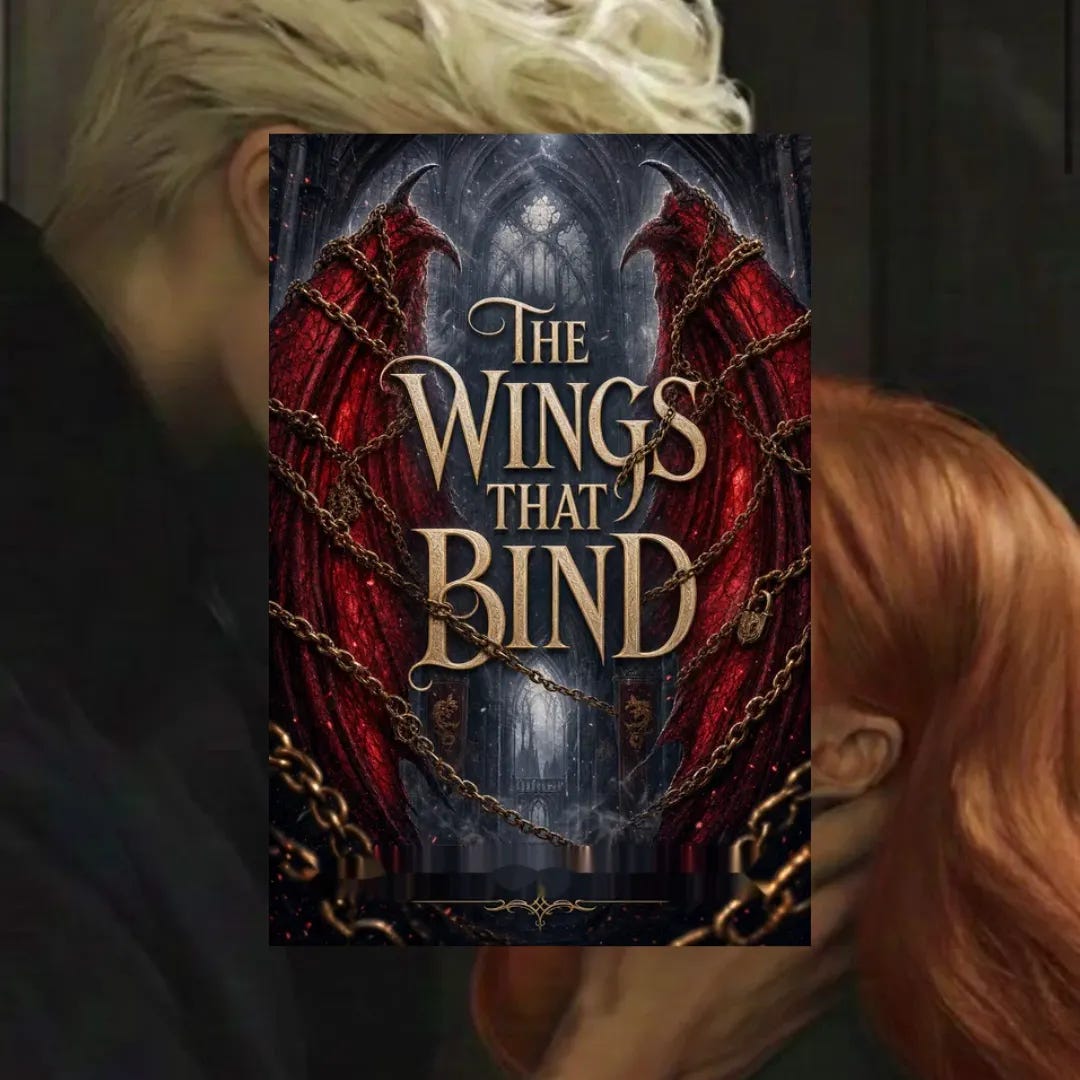
The shape of it: winter break ends with a head on a spike. Viktor installs a new headmistress at Bloodwing and turns the school into a police state, Blake is missing an eye and growing something under his skin, Medra has lost her dragon, her best friend is hiding from the bond that saved her life, a plague is turning highbloods feral, and somewhere out in a sunless forest, two lunatics are hammering cracks into the barrier between worlds. That is a LOT of book. Hold that thought, because “a lot of book” turns out to be the diagnosis.
Let’s get into it.
The Opening Is Vicious and I Said Okay Okay
Credit where it’s due, loudly: this is the best opener since book 1’s corpse pile. The book leads with its most dangerous POV swing, a chapter so brutal I had to sit with it, from inside the head of a character this series taught us to hate. What she pays, what she survives, what she vows afterward. Then the courtyard: a head rotting on an iron stake, a woman forced to tear out her own throat in the snow, and students hopping over the corpse like it’s a game. My actual reaction was “okay okay,” hands up, because that’s a promise. A promise of expanded perspective at maximum intensity, a series growing up in real time.
Here’s the tragedy, and I’ll say it now so the rest of this review makes sense: it’s a promise the book unravels. The opener writes a check the next four hundred pages can’t cash. But the claiming itself? Near flawless, and the quarter flame I held back is only because “okay okay” isn’t the involuntary out-loud “oh yeah!” that book 1 pulled from me. This category measures the hook, and the hook was in my cheek.
Where Did Medra Go?
Now the wound. Where did she GO in this book? Medra Pendragon, the reason I picked up this series, the girl who declared she belongs to no one in front of four houses, spends book 3 feeling like a side character in her own story. She punches, she rallies, she loves, and somehow she’s a guest star. The ensemble takes the wheel: the new headmistress’s arc balloons, the wolf is out of the bag and threading through everything, Florence and Nyxaris drift off into their own subplot that stopped working for me and then took a turn I need to talk about behind the spoiler wall, because listen. I love dragons as much as the next baddie. But icky. I said what I said, and I’ll explain it in the spoiler zone with my whole chest.
And I want to be precise about the complaint, because it’s not “how dare other characters exist.” I don’t mind a side POV here and there, book 2’s expansion scored well with me for exactly that reason, everyone arrived on schedule with an obstacle they’d earned. This is different. This book lost focus and lost the plot that had these characters in it. Too much introduced at once, the center of the series left unattended, and no one made me feel complicit in anything. Blake’s evolution is the one thread still genuinely moving, and admiration for one arc can’t feed a category whose whole test is whether I cared from the inside. I spent this book noticing the machinery. That’s the lowest character score I’ve ever given this series, and it hurt me to type.
The Wrong Couples Stole the Show
Here’s the uncomfortable part, the part where honesty beats loyalty. There IS chemistry in this book, real, crafted ache. And it belongs to the wrong people. The B-plot romance is genuinely well built, blood vows and recognition and one absolutely cinematic moment on a cliff, the kind of slow-trust construction I’d celebrate anywhere else. But I didn’t come here for the understudies. Meanwhile Florence and her dragon absorb whatever oxygen is left, in a direction that made my skin do the wrong kind of crawl. And the central pairing, the beautiful toxic train wreck I’ve been strapped to since book 1? They get moments. A punch, a desk, a windowsill. Moments instead of a current.
My rubric says no spark, no mercy. The spark exists, and it got reassigned to couples I didn’t order. That’s almost worse.
Has Vibes
The atmosphere report, book 3 edition. Book 1 was “seeps, not drenched.” Book 2 was “more seepage, still not drenched.” This one is: has vibes. Not strong, not weak. Present without being weather. Which is genuinely wild when you list what’s on the page, heads on spikes, plague veins crawling up necks, a burning city under two dragons, students playing hopscotch over a corpse. Grimmest wallpaper in the series, same peripheral seep, because the prose still points at the mood instead of pressing it into your lungs. Three books, three sizes of story, identical humidity. At this point I’m calling the ceiling structural.
I Was Bored During an Apocalypse
Full honesty, that’s the platform. This book bored the shit out of me. There, it’s in print.
And I can tell you exactly why, because it’s not the events. A city burns. Dragons duel over it. A lullaby stops a monster mid-rampage. On paper this is the most spectacular installment of the series, and I was checked out for entire stretches of it, because immersion doesn’t run on events, it runs on caring whose events they are, and this book misplaced that person two hundred pages earlier. The POV scatter didn’t just dilute the characters, it dissolved the momentum. Books 1 and 2 at least had the formula, hot open, saggy political middle, detonating finale, and I dinged them for it while secretly relying on that finale to pay me back. Book 3 doesn’t even hold the shape. There’s no center of gravity to sag away from and return to, just threads multiplying while my investment quietly drained out the bottom.
The stake I planted in the last review said the shape either breaks or starts costing flames. It broke, and then it cost flames anyway.
The Themes Still Carry, But One of Them Tried to Dodge the Bill
Because this is still a Boleyn book, the cargo is real even through the fog. Protection as control is a genuinely new angle for this series, every act of “keeping safe” doubling as a cage, and the book is smart enough to indict everyone with it. The plague literalizing what the highbloods always were, predators whose politeness was only ever a costume. And the new POV refuses moral cleanliness in a way the first two books never attempted, perpetrator and victim in the same body, both true at once. That’s heavyweight material, delivered.
But there’s one reveal I’ve been chewing on since I closed the book, and it didn’t sit right, so it goes in print. We learn that blightborn compliance across Sangratha isn’t cultural. It’s magical, generational compulsion woven into the population.
The whole social order is an enchantment.
And I get why that’s a juicy twist, but think about what it does to the series’ best argument: if the system is a spell, nobody built it, nobody maintained it, nobody benefited from it on purpose. It shaves the responsibility off everyone. It’s the fantasy version of “sure, my ancestors owned slaves, but why should I have to repair anything they did.” The first two books were RUTHLESS about complicity.
The Crown of Bone made the heroine an instrument of the machine. The enforcer reveal said we’re all somebody’s soldier. This reveal hands the entire cast an exit from that argument, and the book doesn’t interrogate the exit, it just leaves the door propped open.
Maybe book 4 walks through it and does the reckoning. This book didn’t, and the theme that made this series heavyweight got handed a loophole.
No Playlist This Time, and That’s the Review
I need you to understand how much I wanted to build this one. Two playlists deep into this series, hands open, ready to score a third. The dread register was warmed up, the epic drums were on standby, and there’s a scene in this book, a small creature singing through a dragon battle, that on paper is the most playlist-able moment Boleyn has ever written.
But playlists on this platform are emotional architecture, not decoration, and there was no building to hang the music on. I was bored. A playlist has to be earned by a book I was living inside, and I was outside this one looking in for too much of it. So for the first time in this series, and honestly one of the first times ever on this platform: no playlist. The series still wants a soundtrack, of course it does. This installment didn’t earn its track time, and the empty space where the tracklist usually lives is the most honest sentence in this review.
🔥 Dragon Flame Breakdown
Opening Bite — 4.75/5 Vicious, confident, the best opener since book 1. A promise the rest of the book unravels, but the claiming itself was near flawless.
Character Hunger — 2.75/5 The heroine went missing from her own series. Too much introduced, no one made me complicit, and I noticed the machinery instead of living in it.
Chemistry & Connection — 2.75/5 Real crafted ache, assigned to couples I didn’t come for. The central pairing got moments instead of a current.
World & Atmosphere — 3.5/5 Has vibes. Grimmest set dressing in the series, same peripheral seep, and I’m calling the ceiling structural.
Pacing & Immersion — 2.25/5 Bored during the apocalypse. The POV scatter dissolved the momentum, and the formula didn’t break so much as collapse.
Thematic Weight — 3.75/5 Protection as control lands, moral messiness lands, and one big reveal quietly refunds the complicity the first two books charged everyone for.
Soundtrack Potential — 3/5 Scenes that gestured at music in a book that never made it inevitable. The playlist slot is empty on purpose.
🐲 Final Verdict: 22.75/35 —
Mood-Dependent
Good with caveats. Read for the feeling, not the logic, and the feeling is real: the vibes are strong, the opener is vicious, the villain gets more monstrous, and the themes still carry weight even where the delivery wobbles. But the series trajectory tells the story my heart already knew: 29.25, then 27.75, then this. This is the installment where the expansion became the whole meal, the heroine became a guest star, and the shape didn’t just cost flames, it came apart.
I’m not off this series, let me be clear. The ending, which we’ll discuss behind the wall, sets up a book 4 with genuine stakes, and I will absolutely be there, because Blood Oaths were sworn in books 1 and 2 and I honor my oaths. But I’m walking in with adjusted expectations and a simple demand: give me my girl back. Put Medra at the center of her own story, close the loophole you opened, and this series can climb right back into the tiers where it started.
If you made it this far, you already know you’re not leaving without subscribing. Flames over stars, always. Playlists only when they’re earned, apparently. A verdict every time, no hedging.
⚠️ SPOILER ZONE ⚠️
Everything below discusses the reveals, the POV swings, the icky thing, and that ending. Come back after. I’ll be here with adjusted expectations and a lot of feelings.
Regan first, because the opener deserves its due even in the autopsy. The book opens with her being claimed by Viktor as his consort, her father having signed the contract to buy her little brother’s survival, and it is the most brutal chapter this series has attempted. She dissociates through it, counts what each moment buys, and vows afterward to make them all fear her. That’s a villain rebuilt into a victim rebuilt into a threat in one chapter, and her arc stays the best-constructed thing in the book: implementing the lockdowns while counting her own bruises, perpetrator and victim with no moral cleanliness offered. Her endgame move, poisoning Viktor with the wolf blood threaded through her veins from a Blood Vow made months earlier, is genuinely elegant plotting. Chekhov’s handshake. I respect it. I also spent her every chapter aware that this excellence was being purchased with Medra’s page time, and both things are true at once, which is very on-theme for this series, I suppose.
The Kage and Regan of it all: the cliff scene where the wolf watches her and names Viktor’s bruises for what they are, the line about seeing the difference between a monster and the one wearing its chains, the Blood Vow. Objectively? Beautiful construction. The best romantic beat in the book. And it belongs to the B-plot, which is exactly my problem distilled into one gorgeous, misallocated scene.
Now the icky thing, since I promised. Florence and Nyxaris. The bond that saved her life in book 2’s finale spends this book pulling her somewhere the text keeps describing as unexpectedly intimate, and there are dream sequences I was not prepared for and did not want. Listen. I love dragons as much as the next baddie. I have a whole brand about it. But there’s a line between “the bond is deep and complicated” and where this book keeps drifting, and every time it drifted I was pulled straight out of the story to go stare at a wall. Florence’s actual arc, coward on the cliff to scholar-warrior firing emberfern bolts over a burning city, is genuinely good. Her academic preparation becoming the weapon when swords fail, the greenhouse research saving the day, I love all of that. It’s wrapped around a dynamic I couldn’t stop side-eyeing, and the side-eye won.
Blake’s thread is the one that still moves like the series I fell for. The missing eye, Viktor’s handiwork. The scales climbing his arms, the second consciousness eating him alive, and the reveal that this soul-splitting will kill him. So he does the most Blake thing imaginable: he finds a forbidden spell and secretly bargains with an ancient Inferni named Vorago to devour his parasite dragon, walks away feeling cured, light, whole, and never feels the far worse thing settle into the hollow. Protection as control, concealment as catastrophe, the book’s whole thesis in one terrible decision. Because of course the real monster wears silence as a disguise. And when Viktor feeds a beloved professor to an infected guard to force Blake’s hand, Vorago erupts and burns Veilmar, a whole city, swallowing fleeing figures whole while the school watches from the towers. The series finally made Blake the weapon Viktor always wanted, and the cost is children. That windowsill scene afterward, Blake human again with his legs over the drop saying he deserves the fall, Medra saying I love you out loud for the first time and yanking him back, and then chains arriving and Vorago tearing him out of her arms and through the window. That’s the ending. Her declaration, his abduction by his own body, gone into the dawn.
And Neville. The fluffin sang a lullaby through a dragon battle and dimmed a monster’s rage because something of Blake stirred under the scales, and for one scene the book remembered exactly what this series does better than anyone: the smallest sincerity outweighing the largest violence. Delicate as spun glass, cutting through the roar. If the whole book had trusted that instinct, we’d be in Blood Oath territory right now.
The Veil stuff, Marcus and Catherine hammering cracks into the barrier from the Bonewood, Orcades cheerfully spying from inside a corrupted dragon, the plague possibly leaking through from the other side, is all table-setting for book 4, and honestly it’s a table I want to sit at. The pieces are good. The heroine exists. Put them back together, Briar. I’ll be there with my flames ready.